Lesson 4: Probability Basics
Calendar
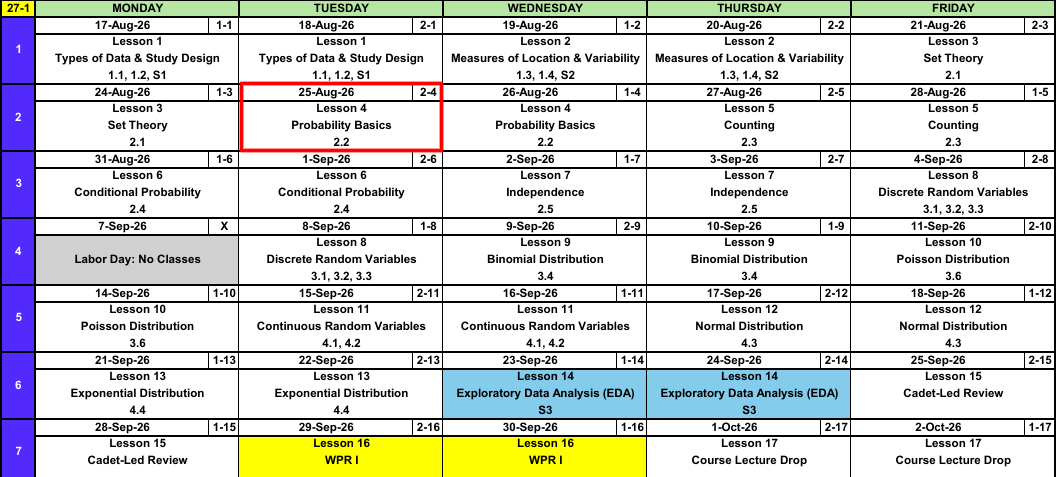
What We Did: Lessons 1 through 3
NoteReview: Data, Study Design, and Summaries (Lessons 1 and 2)
- Population vs sample, parameter (\(\mu\), \(\sigma\), \(p\)) vs statistic (\(\bar{x}\), \(s\), \(\hat{p}\)).
- Random sampling buys generalization, random assignment buys causation.
- Center: mean, median, trimmed mean. Spread: \(s^2\), \(s\), and the fourth spread \(f_s\).
NoteReview: Set Theory (Lesson 3)
- An experiment is any activity whose outcome is uncertain, the sample space \(\mathcal{S}\) is the set of all its outcomes, and an event is any subset of \(\mathcal{S}\).
- Union \(A \cup B\) is “or”, intersection \(A \cap B\) is “and”, complement \(A'\) is “not”.
- \(A\) and \(B\) are mutually exclusive when \(A \cap B = \emptyset\).
- De Morgan: \((A \cup B)' = A' \cap B'\) and \((A \cap B)' = A' \cup B'\).
- We ended by counting hands in this room and dividing every count by \(n\). Those quotients are what today is about.
Last lesson gave us a precise language for saying what might happen. Today we attach a number to it.
What We’re Doing: Lesson 4
Objectives
- State and apply the axioms and basic properties of probability. (SLO 7)
- Apply the addition rule, including its extension to three events. (SLO 7)
- Compute probabilities of events using equally likely outcomes and complements. (SLO 7)
Required Reading
Devore 2.2
Open Vantage
Go to MA206 workspace in Vantage. Bookmark it. That is where the project data lives.
Break!
Reese
Cal


The Takeaway for Today
NoteKey Concepts from Lesson 4
- A probability \(P(A)\) is a number attached to an event. Frequentists read it as a long run relative frequency, Bayesians read it as a degree of belief, and in this course we read it the frequentist way.
- Either way it obeys three axioms: it is never negative, the whole sample space gets 1, and probabilities of mutually exclusive events add.
- Everything else today is a consequence of those three, not a new assumption.
- Complement rule: \(P(A') = 1 - P(A)\). Use it every time you see “at least one”.
- Addition rule: \(P(A \cup B) = P(A) + P(B) - P(A \cap B)\). Subtract the overlap you counted twice.
- Equally likely outcomes: if \(\mathcal{S}\) has \(N\) equally likely outcomes and \(A\) contains \(N(A)\) of them, then \(P(A) = N(A)/N\). Probability becomes counting.
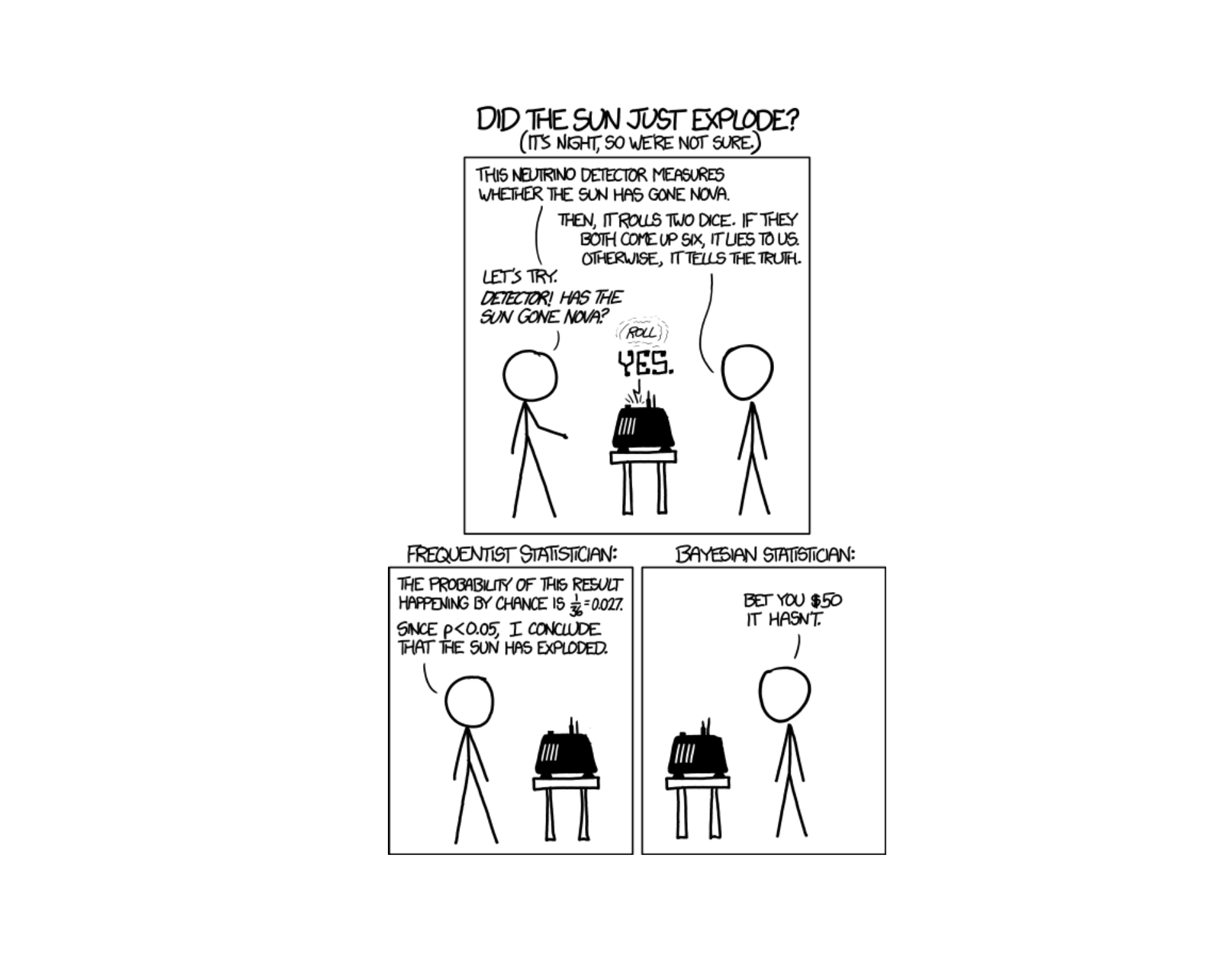
What Is a Probability?
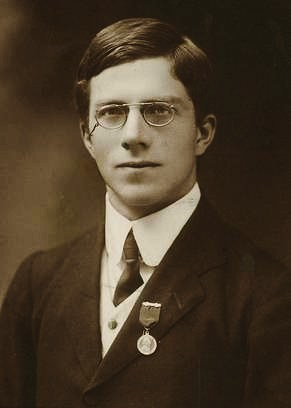
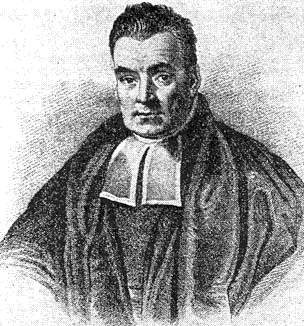
Well, that depends on who you ask.
1890 to 1962
the frequentist
1701 to 1761
the Bayesian
- Frequentists define a probability as a long run relative frequency.
- Bayesians define a probability as a degree of belief that gets updated as evidence arrives.
For the purposes of this class we are going to think like a frequentist.
But the world is becoming more Bayesian, and here is why.
- The computers finally showed up.
- Machine learning is belief updating.
- The Army rarely repeats an experiment 1,000 times.
- It answers the question people actually ask.
So what does this mean in practice?
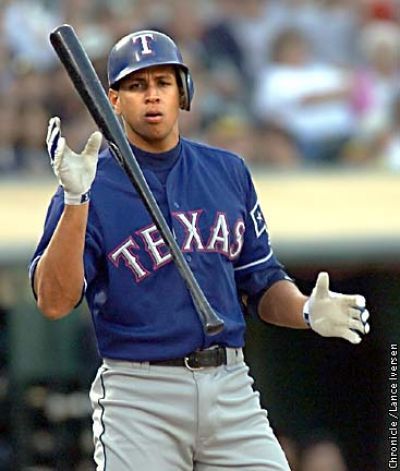
Lance Iversen / San Francisco Chronicle
.295
career batting average
3,115
hits
10,566
at bats
Here is a career for a true .295 hitter, one at bat at a time.
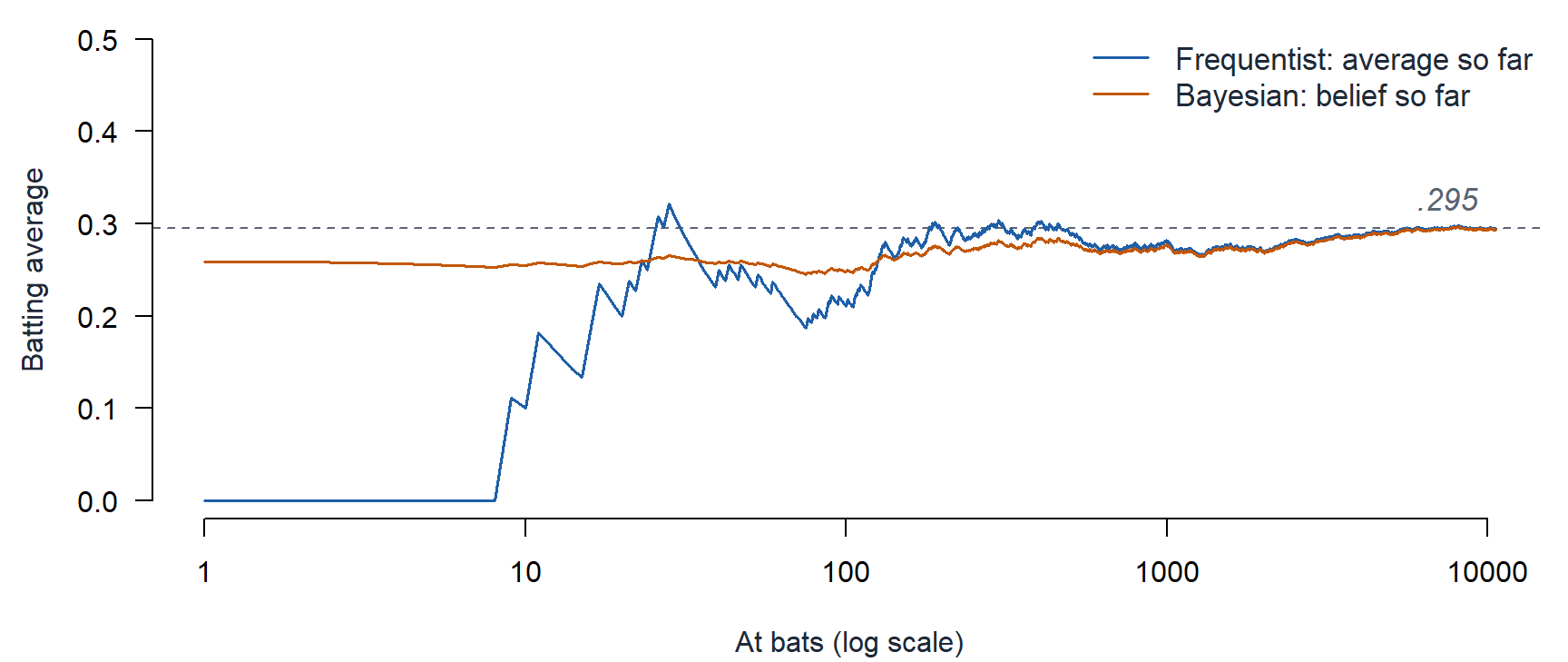
- Frequentist: .295 is a fixed property of the hitter. The line is our estimate chasing it.
- Bayesian: big league hitters live around .260, so that is where we start. Every at bat updates the belief.
He opens 0 for 8. The frequentist calls him a .000 hitter. The Bayesian has him at .253.
After 1,000 at bats, you cannot tell the two apart.
This is why nobody believes a .450 average in April.
What Everyone Agrees On: The Axioms
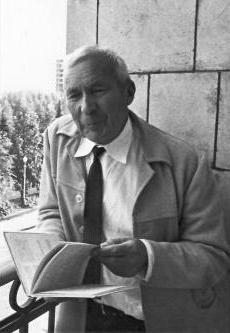
In 1933 he reduced all of probability to three requirements. Everything in the rest of this course sits on top of them.
ImportantThe Three Axioms of Probability
For an experiment with sample space \(\mathcal{S}\), a probability assignment gives each event \(A\) a number \(P(A)\) satisfying:
Axiom 1 (nonnegativity). \(P(A) \ge 0\) for every event \(A\).
Axiom 2 (normalization). \(P(\mathcal{S}) = 1\).
Axiom 3 (additivity). If \(A_1, A_2, A_3, \ldots\) are mutually exclusive events, meaning no two of them can occur together, then \[P(A_1 \cup A_2 \cup A_3 \cup \cdots) = P(A_1) + P(A_2) + P(A_3) + \cdots\]
It is just common sense made precise.
Equally Likely Outcomes
For this lesson, lets look at the circumstances where we have equally likely outcomes. (vs not equally likely, that is for a later lesson)
ImportantEqually Likely Outcomes
If \(\mathcal{S}\) has \(N\) equally likely outcomes and \(A\) contains \(N(A)\) of them, then
\[P(A) = \frac{N(A)}{N}\]
One Card From a Deck
Draw one card at random from a standard 52 card deck: four suits of 13, and 12 face cards (J, Q, K in each suit).
- \(A\) = the card is a heart, \(N(A) = 13\)
- \(B\) = the card is a face card, \(N(B) = 12\)
- \(A \cap B\) = a face card that is also a heart (J, Q, K of hearts), \(N(A \cap B) = 3\)
- \(A \cup B\) = a heart or a face card, \(N(A \cup B) = 22\)
The draw is random, so all \(N = 52\) outcomes are equally likely and each card has probability \(1/52\). Everything else today is counting.
\[P(A) = \frac{13}{52} = 0.250 \qquad\qquad P(B) = \frac{12}{52} \approx 0.231\]
\[P(A \cap B) = \frac{3}{52} \approx 0.058 \qquad\qquad P(A \cup B) = \frac{22}{52} \approx 0.423\]
The intersection and the union are counted exactly the same way. Three cards are both a heart and a face card. Twenty two cards are one or the other: 13 hearts plus the 9 face cards that are not hearts. Hold onto both numbers.
The Complement Rule
ImportantComplement Rule
\[P(A') = 1 - P(A)\]
What is the probability the card is not a heart?
\[P(A') = 1 - P(A) = 1 - 0.250 = 0.750\]
Count it the long way as a check: \(52 - 13 = 39\) cards are not hearts, and \(39/52 = 0.750\).
The Addition Rule
ImportantAddition Rule for Two Events
For any two events \(A\) and \(B\), \[P(A \cup B) = P(A) + P(B) - P(A \cap B)\]
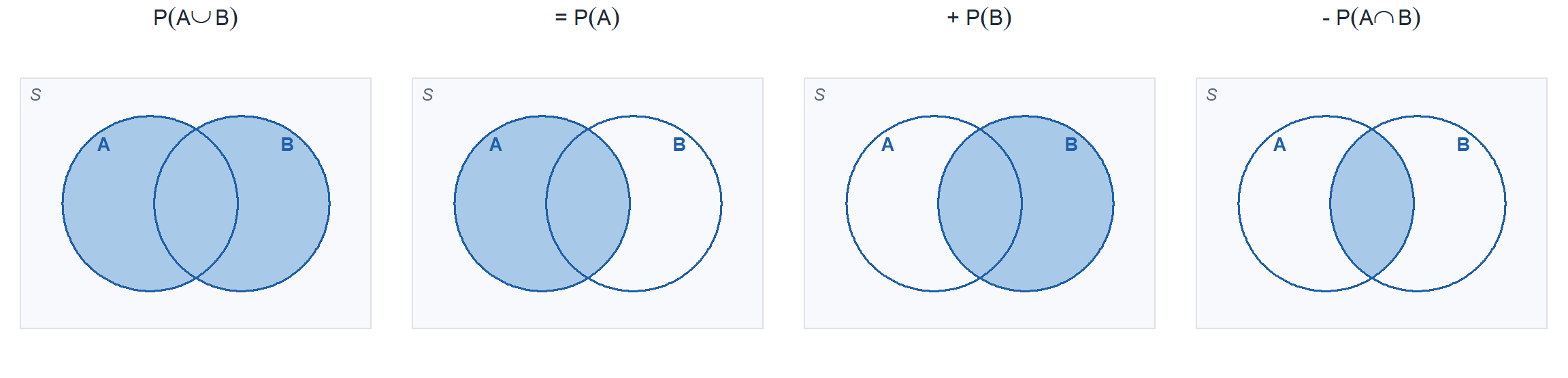
Read it as an equation. The union on the left is what we want. Shade \(A\), then shade \(B\), and the lens in the middle gets painted twice, so subtracting \(P(A \cap B)\) once repairs it.
Back to the Deck
Same deck. What is the probability the card is a heart or a face card?
We already have the three pieces the rule needs:
- \(P(A) = \dfrac{13}{52}\), the hearts
- \(P(B) = \dfrac{12}{52}\), the face cards
- \(P(A \cap B) = \dfrac{3}{52}\), the jack, queen, and king of hearts
Write the rule down first, then substitute:
\[P(A \cup B) = P(A) + P(B) - P(A \cap B)\]
\[P(A \cup B) = \frac{13}{52} + \frac{12}{52} - \frac{3}{52} = \frac{22}{52} \approx 0.423\]
Which is the 22 we counted by hand at the start. The rule got there without counting, and that matters, because on most problems nobody hands you the deck to count.
Special Case: Mutually Exclusive Events
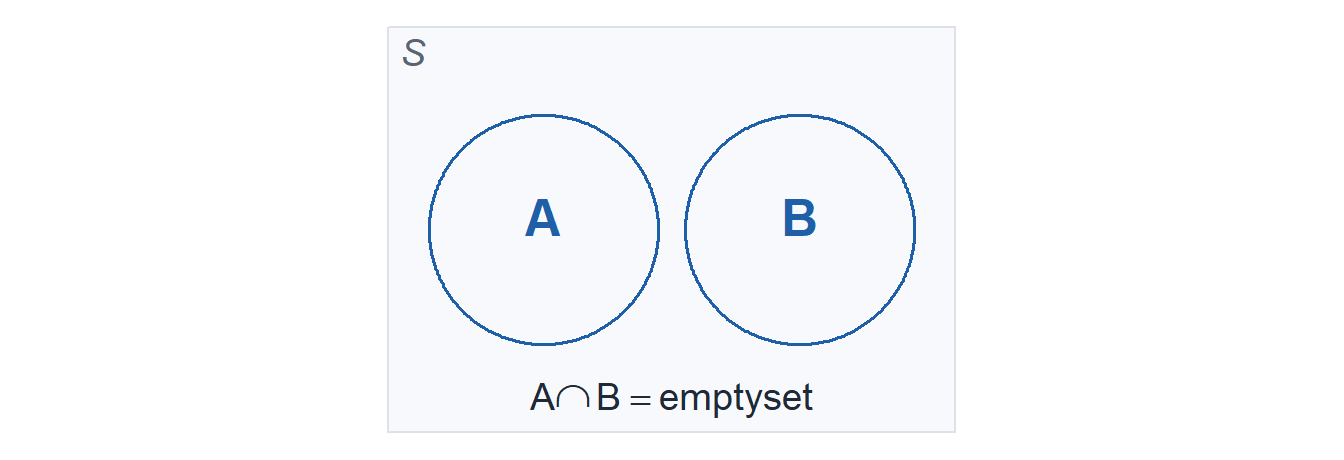
If \(A\) and \(B\) cannot both occur, then \(A \cap B = \emptyset\) and \(P(A \cap B) = 0\). There is nothing to subtract, and the rule collapses to
\[P(A \cup B) = P(A) + P(B)\]
which is just Axiom 3 for two events.
Back to the Deck Again
Same deck, two new events:
- \(B\) = the card is a face card (J, Q, K), \(N(B) = 12\)
- \(C\) = the card is an even numbered card (2, 4, 6, 8, 10), \(N(C) = 20\)
Can a card be both? No. A jack is not a 4. So \(B \cap C = \emptyset\).
Same rule as always, written out in full:
\[P(B \cup C) = P(B) + P(C) - P(B \cap C)\]
The two events are mutually exclusive, so that last term is zero:
\[P(B \cup C) = \frac{12}{52} + \frac{20}{52} - 0 = \frac{32}{52} \approx 0.615\]
Compare that to the heart and face card pair above, where 3 cards sat in both circles and the correction term was doing real work. Check for overlap before you decide which version to use.
Examples
Majors and Club Sports
Of the 400 cadets in a class, 240 are in a STEM major (\(S\)), 150 play a club sport (\(C\)), and 90 do both. One cadet is selected at random.
- Find \(P(S)\), \(P(C)\), and \(P(S \cap C)\).
- Find \(P(S \cup C)\).
- Find the probability the cadet is neither a STEM major nor a club sport athlete.
- Find the probability the cadet is a STEM major but not a club sport athlete.
TipAnswers
\(P(S) = 240/400 = 0.60\), \(P(C) = 150/400 = 0.375\), and \(P(S \cap C) = 90/400 = 0.225\).
\[P(S \cup C) = 0.60 + 0.375 - 0.225 = 0.75\] Adding without subtracting gives \(0.975\), which would claim almost the entire class is one or the other. The 90 double counted cadets are the entire difference.
Neither is \((S \cup C)'\), so by the complement rule \[P\big((S \cup C)'\big) = 1 - 0.75 = 0.25\] That is 100 cadets, and De Morgan says the same region is \(S' \cap C'\).
\[P(S \cap C') = P(S) - P(S \cap C) = 0.60 - 0.225 = 0.375\] Take all of \(S\) and remove the overlap, which leaves the part of \(S\) sitting outside \(C\).
The Same Example in a Table
Two events cut the sample space into exactly four pieces, so every problem like the one above fits in a \(2 \times 2\) table. The four inside cells are the intersections, the edges are the marginal probabilities, and the corner is always 1.
| \(C\) | \(C'\) | Row total | |
|---|---|---|---|
| \(S\) | \(P(S \cap C)\) | \(P(S \cap C')\) | \(P(S)\) |
| \(S'\) | \(P(S' \cap C)\) | \(P(S' \cap C')\) | \(P(S')\) |
| Column total | \(P(C)\) | \(P(C')\) | \(1\) |
Filled in with the cadet numbers:
| \(C\) | \(C'\) | Row total | |
|---|---|---|---|
| \(S\) | \(0.225\) | \(0.375\) | \(0.600\) |
| \(S'\) | \(0.150\) | \(0.250\) | \(0.400\) |
| Column total | \(0.375\) | \(0.625\) | \(1\) |
TipWhy the table is worth the trouble
Every question from the example is now a lookup or a small sum. \(P(S \cup C)\) is the three cells that are not \(S' \cap C'\), so \(1 - 0.25 = 0.75\). “Neither” is the single cell \(0.25\). Nothing gets double counted, because each cell is counted once by construction.
Get comfortable with this table now. In Lesson 6 conditional probability is nothing more than rescaling one row or one column of it.
Another Way of Looking At It
The rule has four quantities in it. Give me any three and I can get the fourth.
In a platoon, 60 percent qualify expert on the rifle (\(R\)), 45 percent max the ACFT (\(F\)), and 75 percent do at least one of the two.
- What percent do both?
- What percent do neither?
TipAnswers
- Start from the addition rule and solve for the term you do not have:
\[P(R \cup F) = P(R) + P(F) - P(R \cap F)\] \[0.75 = 0.60 + 0.45 - P(R \cap F)\] \[P(R \cap F) = 0.60 + 0.45 - 0.75 = \mathbf{0.30}\]
30 percent do both. Sanity check with monotonicity: \(0.30\) is smaller than both \(0.60\) and \(0.45\), as an intersection has to be.
- “Neither” is the complement of the union, so the two rules work together:
\[P\big((R \cup F)'\big) = 1 - P(R \cup F) = 1 - 0.75 = \mathbf{0.25}\]
25 percent do neither. By De Morgan this same group is \(R' \cap F'\), the soldiers who are not expert and did not max, which is the wording you are more likely to hear.
Three Events
Adding a third event repeats the same repair one level deeper. The pattern has a name: the inclusion exclusion principle.
ImportantAddition Rule for Three Events
\[\small P(A \cup B \cup C) = P(A) + P(B) + P(C) - P(A \cap B) - P(A \cap C) - P(B \cap C) + P(A \cap B \cap C)\]
Add the singles, subtract the pairs, add the triple back. Here is what each step does to the count in every region. We want every region counted exactly once.
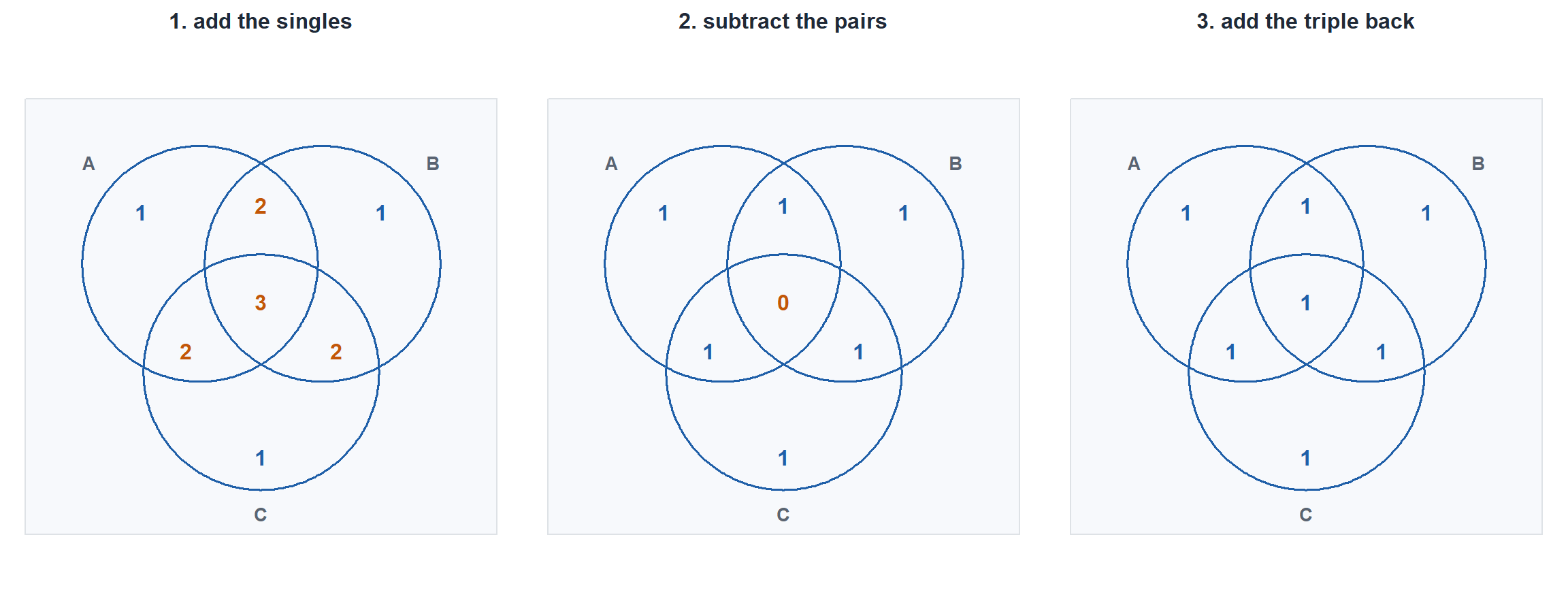
Follow the center region. Adding the singles counts it 3 times. Subtracting the three pairs takes it back down to 0, which is too far. Adding the triple back puts it at exactly 1, and every other region is already there.
Let’s Work an Example: Three Schools
A battalion of 200 soldiers is screened for three schools: Airborne (\(A\)), Air Assault (\(B\)), and Ranger (\(C\)). The diagram shows how many soldiers fall in each of the eight regions.
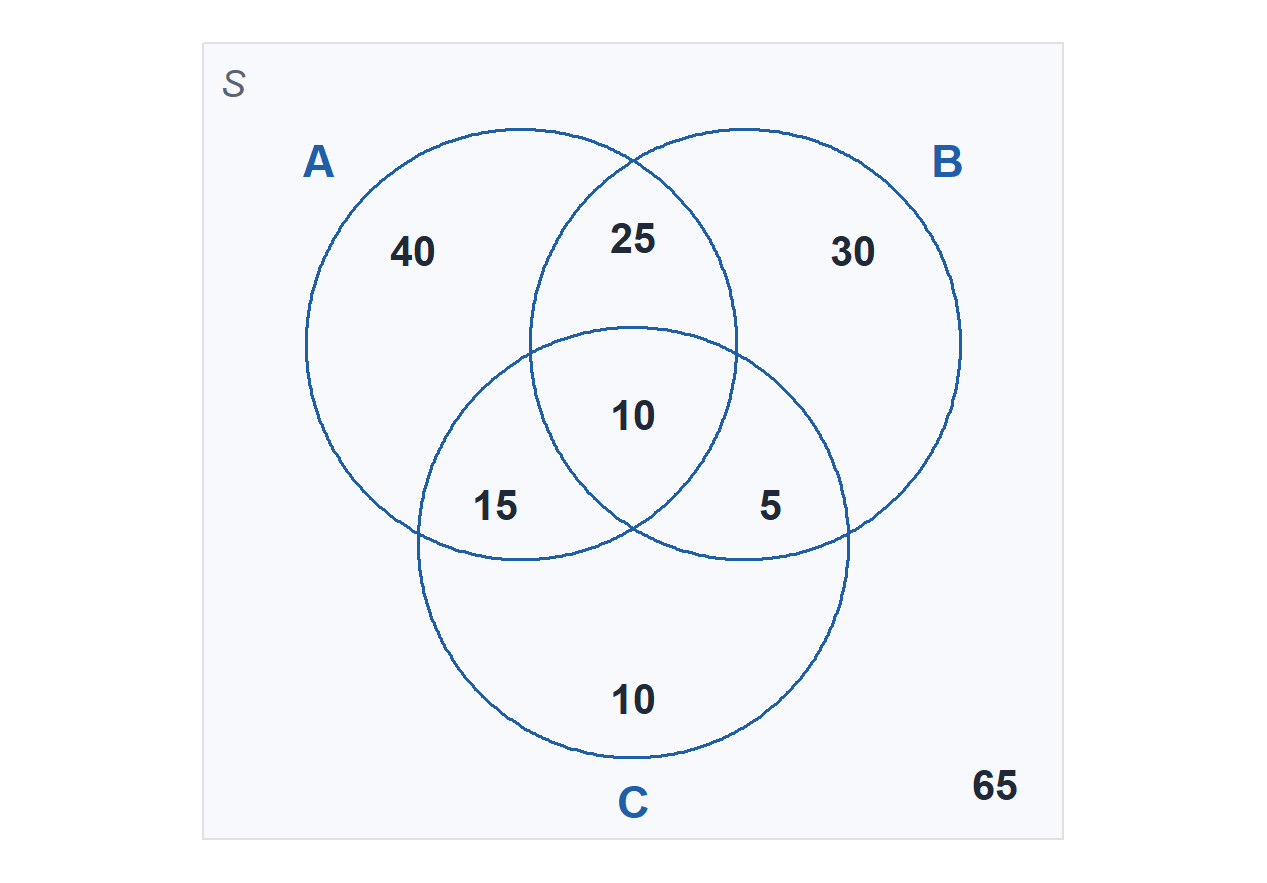
One soldier is selected at random.
- Find \(P(A)\), \(P(B)\), and \(P(C)\).
- Find \(P(A \cup B \cup C)\) two ways: off the diagram, and with the formula.
- Find the probability the soldier holds exactly one of the three schools.
TipAnswers
Each circle is the sum of its four regions. \[P(A) = \frac{40 + 25 + 15 + 10}{200} = \frac{90}{200} = 0.45\] \[P(B) = \frac{30 + 25 + 5 + 10}{200} = 0.35, \qquad P(C) = \frac{10 + 15 + 5 + 10}{200} = 0.20\]
Off the diagram: everything inside at least one circle is \(200 - 65 = 135\) soldiers, so \(P(A \cup B \cup C) = 135/200 = 0.675\).
With the formula: the pairwise counts are \(N(A \cap B) = 25 + 10 = 35\), \(N(A \cap C) = 15 + 10 = 25\), and \(N(B \cap C) = 5 + 10 = 15\), with \(N(A \cap B \cap C) = 10\). So \[P(A \cup B \cup C) = 0.45 + 0.35 + 0.20 - 0.175 - 0.125 - 0.075 + 0.05 = 0.675\] Same answer, which is the point. The formula is what you use when nobody hands you the picture.
- Exactly one means the three outer slices only: \(40 + 30 + 10 = 80\), so \(P = 80/200 = 0.40\). That is not \(P(A \cup B \cup C)\), which also collects everyone holding two or three schools.
Practical Exercise: Your Section, Now in Probability
Pull out the four counts from last lesson: \(L\) = left handed, \(C\) = corps squad athlete, and \(n\) = the number of cadets in this section. If we lost them, take the hands again.
| Corps squad (\(C\)) | Not corps squad (\(C'\)) | Row total | |
|---|---|---|---|
| Left handed (\(L\)) | |||
| Right handed (\(L'\)) | |||
| Column total | \(n =\) |
The experiment: select one cadet from this section at random, so all \(n\) outcomes are equally likely.
Part 1: Fill In the Probabilities
Compute \(P(L)\), \(P(C)\), and \(P(L \cap C)\) from your table.
Compute \(P(L \cup C)\) twice, once with the addition rule and once by counting the three regions straight off the diagram. Do they agree?
Compute the probability of neither two ways: as \(1 - P(L \cup C)\), and as the “neither” cell divided by \(n\).
TipAnswers
Each one is a count over \(n\): the row total, the column total, and the center cell.
They have to agree, and if they do not, the overlap got mishandled on one of the two paths. The addition rule is just the diagram with the double count removed.
They have to agree as well. This is the complement rule and De Morgan doing the same job from two directions, since \((L \cup C)' = L' \cap C'\) is the “neither” cell.
Part 2: Check the Axioms in the Room
Add up the four region probabilities. What do you get, and which axiom is that?
Is any probability in your table negative? Could one ever be?
Are \(L\) and \(L'\) mutually exclusive? What is \(P(L) + P(L')\)?
Is \(P(L \cap C) \le P(L)\)? Explain why that had to be true before you computed anything.
TipAnswers
Exactly 1. The four regions are mutually exclusive and their union is \(\mathcal{S}\), so Axiom 3 plus Axiom 2 force the total to 1. If your four numbers do not total 1, somebody got counted twice or missed.
No, and no. Every entry is a count of people divided by \(n\), and counts are never negative. That is Axiom 1 showing up for free.
Yes, no cadet is both left handed and right handed in this tally, and \(P(L) + P(L') = P(\mathcal{S}) = 1\). A pair like that partitions the sample space.
It had to be. \(L \cap C \subset L\), and a subset cannot be more likely than the set containing it. That is monotonicity, and it is a fast sanity check on any answer you write.
Part 3: Push It (if there is time)
Suppose a cadet computes \(P(L \cup C) = P(L) + P(C)\) and gets \(1.15\). Which axiom did they break, and what did they actually do wrong?
What is the probability that at least one of the next two cadets I call on is left handed? Do not compute it. Just say which complement you would take and what extra information you need.
Our probabilities came from counting this room. What population do they describe, and what are they not entitled to describe?
TipAnswers
They broke Axiom 2, since no probability may exceed 1. The actual error was applying Axiom 3 to events that are not mutually exclusive, which double counted every cadet in the center cell. The number above 1 is the alarm, the missing \(-P(L \cap C)\) is the cause.
Take the complement: \(P(\text{at least one lefty}) = 1 - P(\text{neither is a lefty})\). The missing piece is how the second draw depends on the first, which is conditional probability and independence in Lessons 6 and 7.
They describe this section, exactly, because we counted every member of it. Treating them as the probability for a random cadet in the Corps assumes this section is a random sample of the Corps, which it is not. Lesson 1 already warned us about that.
Board Problems
Problem 1: Range Day
A company is scheduled for two events. Let \(R\) = “the cadet shoots the range” and \(K\) = “the cadet completes the ruck”. For a randomly selected cadet, \(P(R) = 0.70\), \(P(K) = 0.55\), and \(P(R \cap K) = 0.40\).
NoteQuestions
Find \(P(R \cup K)\).
Find the probability the cadet does neither.
Find the probability the cadet shoots the range but does not ruck.
Find the probability the cadet does exactly one of the two.
Build the \(2 \times 2\) table of probabilities and confirm your answers from it.
TipAnswers
\(P(R \cup K) = 0.70 + 0.55 - 0.40 = \mathbf{0.85}\).
Neither is \((R \cup K)'\), so \(1 - 0.85 = \mathbf{0.15}\).
\(P(R \cap K') = P(R) - P(R \cap K) = 0.70 - 0.40 = \mathbf{0.30}\).
Exactly one is the two crescents, \(0.30 + (0.55 - 0.40) = \mathbf{0.45}\), or equivalently \(P(R \cup K) - P(R \cap K) = 0.85 - 0.40 = 0.45\). Note this is not part (a), which also includes the cadets who do both.
| \(K\) | \(K'\) | Row total | |
|---|---|---|---|
| \(R\) | \(0.40\) | \(0.30\) | \(0.70\) |
| \(R'\) | \(0.15\) | \(0.15\) | \(0.30\) |
| Column total | \(0.55\) | \(0.45\) | \(1\) |
Every answer above is now a cell or a sum of cells, and the corner totals to 1 as Axiom 2 demands.
Problem 2: At Least One
Each of four cadets fires a single round at a separate target. The probability that all four miss is \(0.02\).
NoteQuestions
What is the probability that at least one round hits?
Write “at least one hits” and “all four miss” in set notation using \(H_i\) = “cadet \(i\) hits”, then name the rules that connect them.
A cadet says “at least one hits” is the same event as “exactly one hits”. Are they right?
TipAnswers
\(1 - 0.02 = \mathbf{0.98}\). Listing the outcomes with at least one hit means listing 15 of the 16 possibilities. Listing the complement means listing one.
At least one hits is \(H_1 \cup H_2 \cup H_3 \cup H_4\), and all four miss is \(H_1' \cap H_2' \cap H_3' \cap H_4'\). They are complements of each other, which is De Morgan plus the complement rule: \[P(H_1 \cup H_2 \cup H_3 \cup H_4) = 1 - P(H_1' \cap H_2' \cap H_3' \cap H_4')\]
No. “Exactly one” is one slice of “at least one”, which also contains two hits, three hits, and four hits. “Exactly one” is a subset, so its probability is no larger, which is monotonicity again.
Problem 3: Is It Legal?
For each assignment, decide whether it can be a valid probability assignment, and name the axiom or property that decides it.
NoteQuestions
\(P(A) = 0.6\), \(P(B) = 0.5\), \(P(A \cap B) = 0.2\)
\(P(A) = 0.6\), \(P(B) = 0.5\), \(P(A \cap B) = 0.7\)
\(P(A) = 0.4\), \(P(A') = 0.5\)
\(A\) and \(B\) are mutually exclusive, with \(P(A) = 0.6\) and \(P(B) = 0.5\)
TipAnswers
Legal. \(P(A \cup B) = 0.6 + 0.5 - 0.2 = 0.9\), comfortably inside \([0, 1]\), and the overlap is smaller than either event.
Illegal. \(A \cap B \subset A\), so \(P(A \cap B)\) cannot exceed \(P(A) = 0.6\). That is monotonicity. The addition rule flags it too, giving \(P(A \cup B) = 0.4\), which is smaller than \(P(A)\) and impossible for a union.
Illegal. The complement rule requires \(P(A) + P(A') = 1\), and these total \(0.9\). The missing \(0.1\) has nowhere to live.
Illegal. Mutually exclusive means Axiom 3 applies directly, so \(P(A \cup B) = 0.6 + 0.5 = 1.1\), which breaks \(P(A \cup B) \le 1\). Two events that likely cannot avoid overlapping.
Problem 4: The Motor Pool
A vehicle is selected at random from the motor pool. Let \(D\) = “deadlined for parts”, \(M\) = “deadlined for maintenance”, and \(O\) = “operator not licensed”, with \(P(D) = 0.20\), \(P(M) = 0.15\), \(P(O) = 0.10\), \(P(D \cap M) = 0.06\), \(P(D \cap O) = 0.03\), \(P(M \cap O) = 0.02\), and \(P(D \cap M \cap O) = 0.01\).
NoteQuestions
Find the probability the vehicle has at least one of the three problems.
Find the probability the vehicle is fully mission capable with a licensed operator.
Find the probability the vehicle is deadlined for parts only, with no other problem.
TipAnswers
Use the three event addition rule: \[P(D \cup M \cup O) = 0.20 + 0.15 + 0.10 - 0.06 - 0.03 - 0.02 + 0.01 = \mathbf{0.35}\]
That is the complement of “at least one problem”, so \(1 - 0.35 = \mathbf{0.65}\).
Start from \(P(D) = 0.20\) and strip out the parts of \(D\) that touch \(M\) or \(O\). Those two overlaps share the triple, so subtract it once and add it back: \[0.20 - 0.06 - 0.03 + 0.01 = \mathbf{0.12}\] Same add, subtract, add back bookkeeping, applied inside a single circle. Sketch the eight regions and it becomes obvious.
Problem 5: Drawing From the Roster
A platoon has 30 soldiers: 12 in first squad, 10 in second squad, and 8 in third squad. The platoon sergeant draws one name at random for a detail.
NoteQuestions
What makes the outcomes equally likely here, and what is the probability for any one soldier?
Find the probability the soldier is from first or second squad, two ways.
Suppose instead the platoon sergeant picks whoever is standing closest. Are the outcomes still equally likely? What breaks?
TipAnswers
The draw is random, which is exactly what makes all \(N = 30\) outcomes equally likely. Each soldier has probability \(1/30\).
Directly: first and second squads hold \(12 + 10 = 22\) soldiers, so \(P = 22/30 \approx 0.733\). By complement: the only other option is third squad, so \(P = 1 - 8/30 = 22/30\). The two squads are mutually exclusive, so Axiom 3 lets us add \(12/30\) and \(10/30\) with no correction term at all.
No. Soldiers standing near the platoon sergeant are far more likely to get picked, so the outcomes carry different probabilities and \(N(A)/N\) no longer applies. Convenience is not randomness, which is the same warning from Lesson 1 wearing a probability uniform.
Before You Leave
Today
- Two ways to read the same number: long run frequency (ours) and degree of belief. Both obey identical rules
- Three axioms: nonnegative, \(P(\mathcal{S}) = 1\), and mutually exclusive events add. Everything else is derived
- Complement rule \(P(A') = 1 - P(A)\), the tool for every “at least one” problem
- Addition rule \(P(A \cup B) = P(A) + P(B) - P(A \cap B)\), and its three event version: add the singles, subtract the pairs, add the triple back
- Probabilities add without correction only when events are mutually exclusive
- A \(2 \times 2\) probability table organizes any two event problem, and its corner is always 1
- Equally likely outcomes turn probability into counting: \(P(A) = N(A)/N\)
- A probability above 1, below 0, or an intersection larger than its own event means you made an error, not a discovery
Any questions?
Next Lesson
Lesson 5: Counting
- Apply the product rule, permutations, and combinations to count outcomes
- Use counting techniques to compute probabilities of equally likely outcomes
Reading: Devore 2.3
Today ended on \(P(A) = N(A)/N\), which is only useful if you can find \(N(A)\) and \(N\). Next lesson is how to count them without listing them.
Upcoming Graded Events
- WebAssign 2.2 - Due at the start of Lesson 5
- WPR I - Lesson 16 (covers Lessons 1-13)
- TEE - 15-18 Dec 2026